.png "image-(29)")
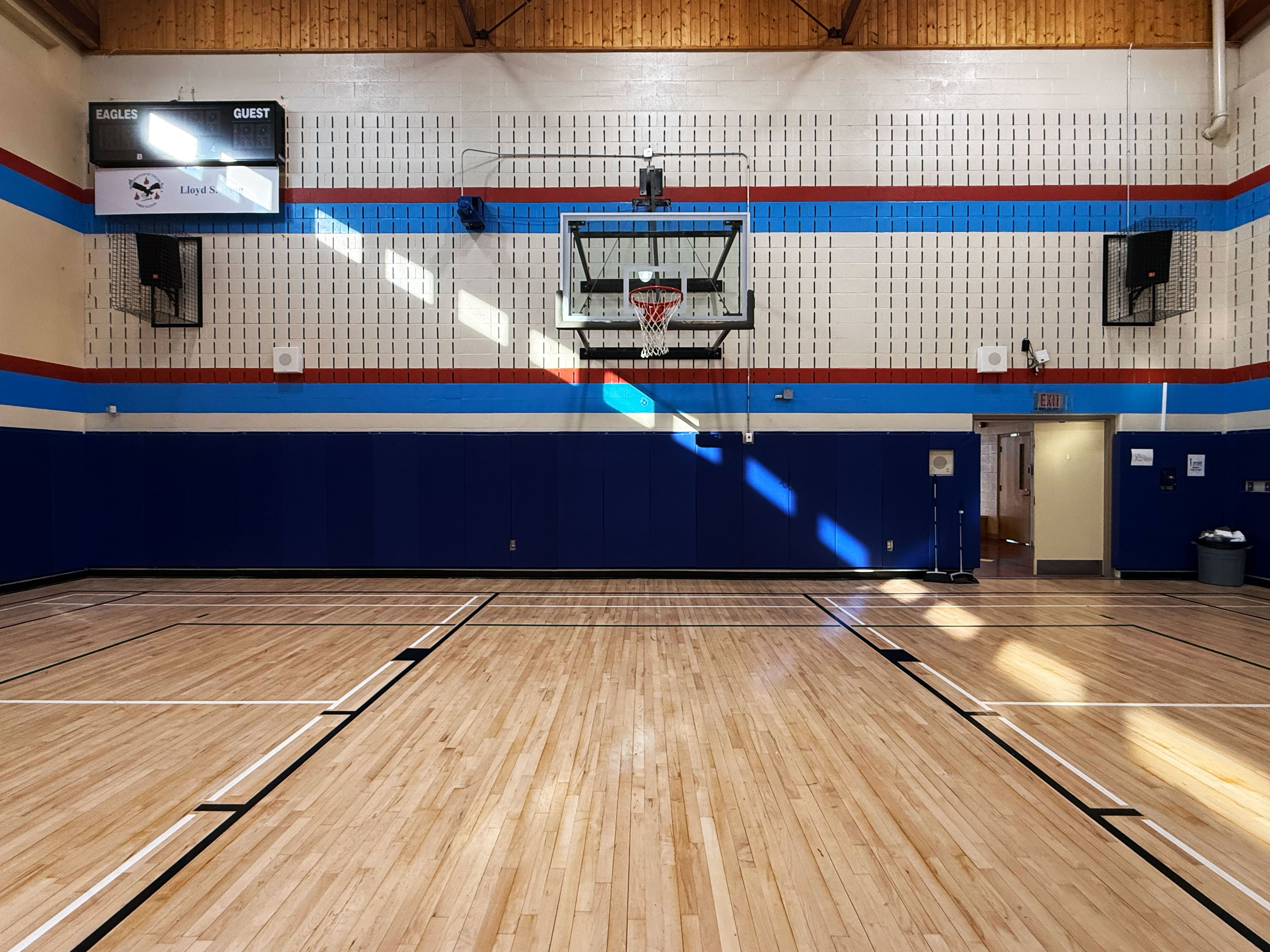
Code-aware planning for wall padding, basketball goal padding, and impact protection in school gymnasiums (U.S. & Canada)
When it comes to high energy spaces, not much can compare to the gymnasiums located inside our schools across the country. These are popular spaces where sports like basketball, volleyball, PE classes and even community events collide, often literally. Here in 2026, gymnasium padding is no longer an optional upgrade, it has now become a core safety requirement driven by athlete performance levels, liability exposure, insurance expectations, and governing body standards both here in Canada and in the United States.
This guide delivers a clear, practical roadmap for school athletic directors, coaches, PE teachers, principals and facility managers, “covering” exactly where padding is needed on basketball courts and multi-sport gyms, how much protection is required, the key standards that matter (NFHS, OPHEA, FIBA, ASTM), and how to select and install safe, durable gymnasium padding that supports code-aware facility planning.
Why Gymnasium Padding Matters More Than Ever in 2026
If you’ve been around youth sports, you’re well aware that today’s student-athletes are faster, stronger, and more athletic than previous generations. Combined with multi-use gym schedules and tighter clearance in older buildings, the risk of wall and structure impacts has increased dramatically. Proper impact protection padding reduces the severity of collisions, protects against head and body injuries, lowers liability risk, and demonstrates due diligence during safety audits or claims.
Core Standards Every School Must Know
ASTM F2440 – The Foundation for Wall and Feature Padding
The primary performance standard across North America is ASTM F2440 (Standard Specification for Indoor Wall/Feature Padding).
As per the specification, compliant padding must demonstrate a Gmax of 200 or below (measures maximum deceleration on impact; lower is better for energy absorption), HIC (Head Injury Criterion) under 1000 (assesses risk of head injury) and proper installation height and coverage.
Pads that do not meet these metrics should never be accepted for school use. Always request current test documentation from the manufacturer where applicable.
Installation Rules That Matter
- Bottom of padding no more than 4 inches (10 cm) above the playing surface
- Coverage of all hard surfaces an athlete can reasonably contact
- Secure mounting that prevents dislodgement during play
- Fire performance: Prefer Class A (ASTM E84) or Canadian equivalent (CAN/ULC-S102)
U.S. Standards – NFHS Basketball Guidance
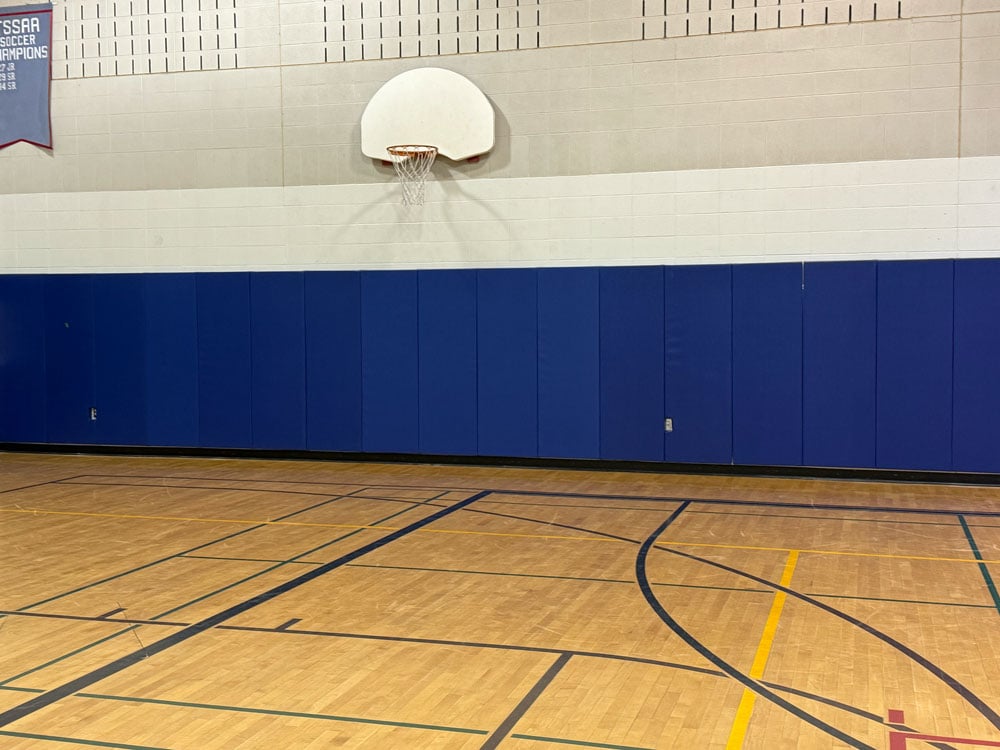
The National Federation of State High School Associations (NFHS) requires at least 3 feet (preferably 10 feet) of unobstructed space outside court boundaries and mandates that backboard edge padding on boards be used for competitive play, along with a clear expectation that facilities address hard surfaces near play areas
Even when minimum clearance exists, we strongly recommend padding all walls, columns, and corners within the preferred 10-foot zone, especially behind goals and along end lines.
Canadian Standards – OPHEA, FIBA & Provincial Guidance
In Canada, school sport is governed provincially, and safety standards are set through a combination of provincial athletic associations, education ministry guidelines, and specialized resources such as OPHEA.
OPHEA (Ontario Physical Activity Safety Standards in Education)
OPHEA provides some of the most specific and widely respected school gymnasium padding requirements in Canada. Many other provinces reference or adapt similar language.
When a student’s follow-through could result in contact with a wall or stage beyond the key area:-
-
- Protective gym mats or padding must be installed.
-
- Minimum height: 1.8 m (6 ft) up the wall (measured from the top of the baseboard).
- Maximum distance from the floor: 10 cm (4 inches).
- Minimum width of coverage: 4.8 m (16 ft).
- Minimum thickness: 5 cm (2 inches) (cross-link foam, open-cell foam, polyurethane, dual-density, or manufacturer-equivalent compaction rating).
- Rectangular backboards require protective padding on the lower edges and corners.
- Winches for movable backboards must not be located directly under the supporting wall-mounted structure.
These OPHEA standards align closely with ASTM F2440 performance expectations and the 4-inch maximum floor gap used in North American best practice.
FIBA Rules (Used by OFSAA and Many Provincial Championships)
OFSAA (Ontario) and numerous other provincial high school championships follow FIBA rules requiring backboard padding on the bottom and side edges (specific thickness ranges of 20–55 mm depending on location), padding on backboard support structures and a very strong recommendation to pad walls and obstructions around the court for player safety.
Provincial Athletic Associations & Fire Standards
- Each province has its own high school athletic association (e.g., OFSAA, BC School Sports, ASHSA, MHSAA, etc.).
- Most defer to FIBA for competition rules and expect schools to follow provincial education safety standards or OPHEA-style guidelines.
- Fire performance in Canadian schools typically references CAN/ULC-S102 or ASTM E84 Class A — both of which quality fire-retardant padding meets.
- ASTM F2440 remains the key performance standard for impact attenuation used by Canadian manufacturers and facility managers.
Where School Basketball Courts Need Padding: The Priority Map
Use this checklist when auditing or planning a school gym:
1. End Walls Directly Behind Basketball Goals (Highest Priority)
This is the most common high-speed impact zone, as players are often driving to the basket, contesting rebounds, or losing balance and frequently contact these walls. Full-height coverage (typically 6 feet / 1.8 m tall) is essential and custom cutouts for outlets, switches, or vents are standard.
Canadian note: OPHEA specifically requires padding beyond the key that extends at least 1.8 m up the wall and a minimum of 4.8 m wide.
2. Side Walls and Sideline Areas
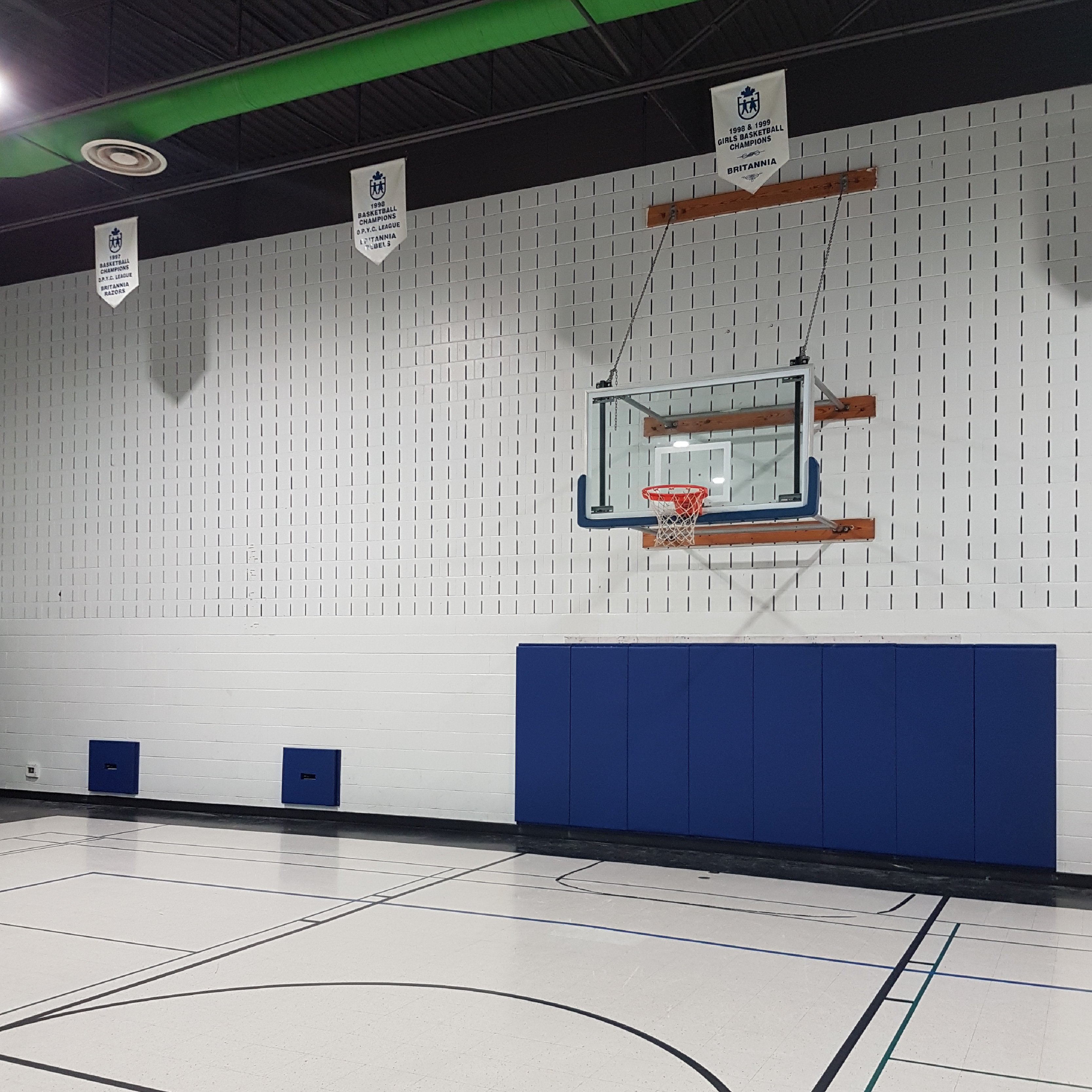
Especially important in multi-court or practice configurations where players can run out of bounds. Cover hard surfaces within the 10-foot / 3-metre preferred buffer.
3. Columns, Beams, and Structural Posts
Often overlooked but extremely dangerous. Custom column protection or post wraps are critical as they tend to be free-standing in nature. These should always be designed to match wall padding aesthetics and performance.
4. Corners and Outside Edges
Outside corners concentrate force and should always be padded.
5. Basketball Goal / Backboard / Pole Padding
Backboard edge padding: Required by NFHS (U.S.) and FIBA (Canada/many provincial championships). Covers the hard frame edges to protect heads and hands.
Pole / upright padding: Highly recommended (often 6 feet tall, 2–4 inches thick). Protects against collisions with support structures.
Base padding (for portable systems): Minimum 4-inch thick coverage on main bases.
6. Stage Fronts, Bleacher Ends, and Other Hard Features
Any elevated or protruding hard surface near activity areas. This includes custom stage padding that is designed and manufactured with a 6” return which is used to cover the top of the stage surface. Used in conjunction with a pair of Velcro strips to secure the padding to the stage or to allow the padding to be removed for special events.
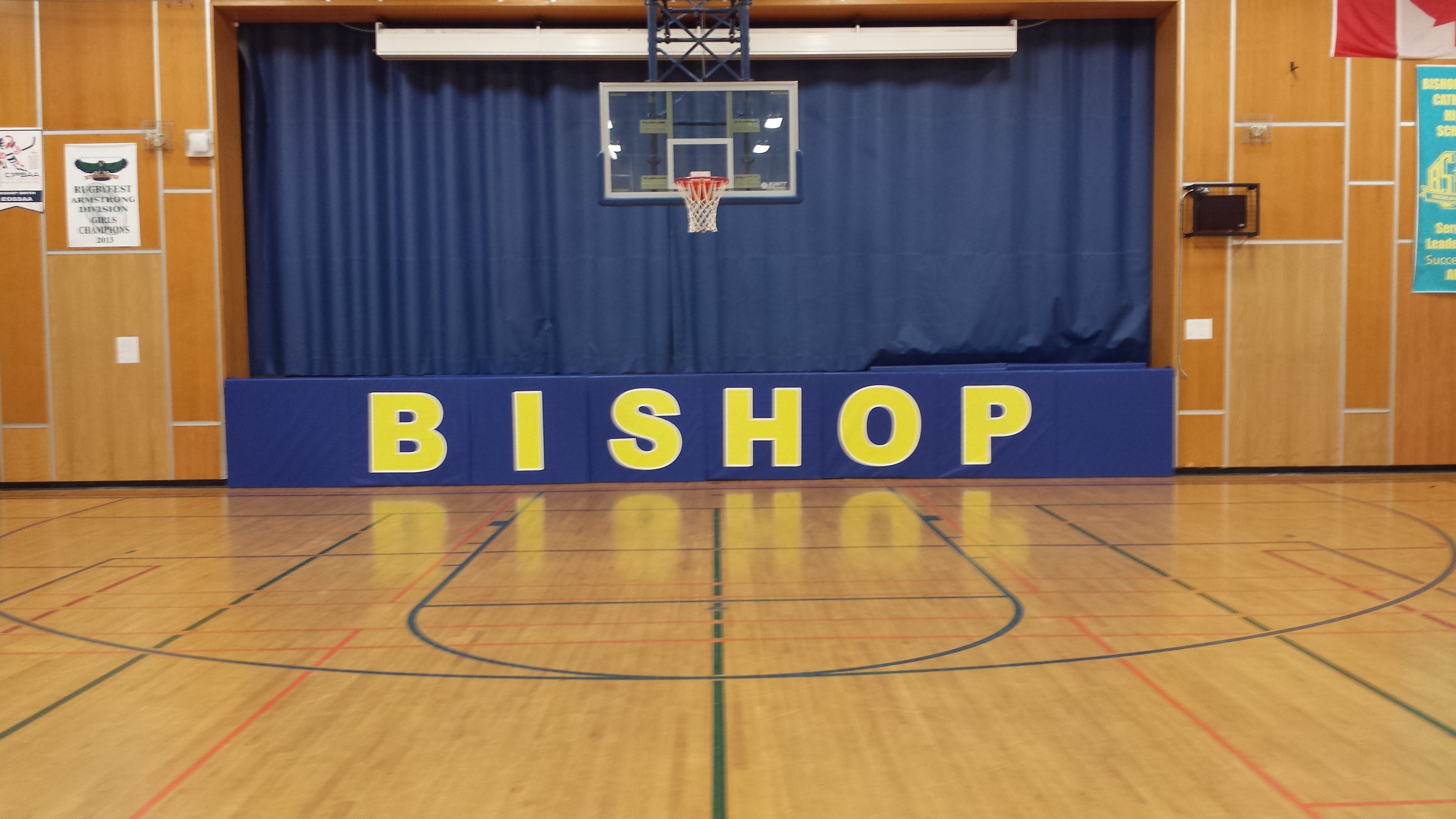
This padding, like any of our other padding products, are available in a variety of colour options and can be customized with screen printed school or team logos.
When Should You Replace Gymnasium Padding?
We generally recommend that facilities should inspect their wall padding systems annually and plan for replacement based on condition rather than age alone. With some facilities seeing a higher volume of activity than others, there is no tried and true way to attach baseline lifecycle estimates to any one set of pads. That said, we believe a good rule of thumb is that most padding systems should be evaluated for replacement roughly every 7 to 10 years, again, depending on usage intensity.
Look for foam that remains compressed after impact, visible cracks or tears in the vinyl surface, persistent odors that do not respond to cleaning, panels that shift or detach from mounting hardware, and discoloration or fading as signs that can indicate that replacement may be looming.
We never recommend patching or attempting to repair installed padding as that can give users and operators a false sense of compliance and protection.
What Installation Methods Work for School Gymnasiums?
Several installation methods exist for gymnasium wall padding, and the right choice depends on your facility's specific needs. Sport Systems offers both permanent and removable configurations to accommodate different requirements, but in the vast majority of cases, we highly recommend using a permanent solution.
Permanent Wall Padding
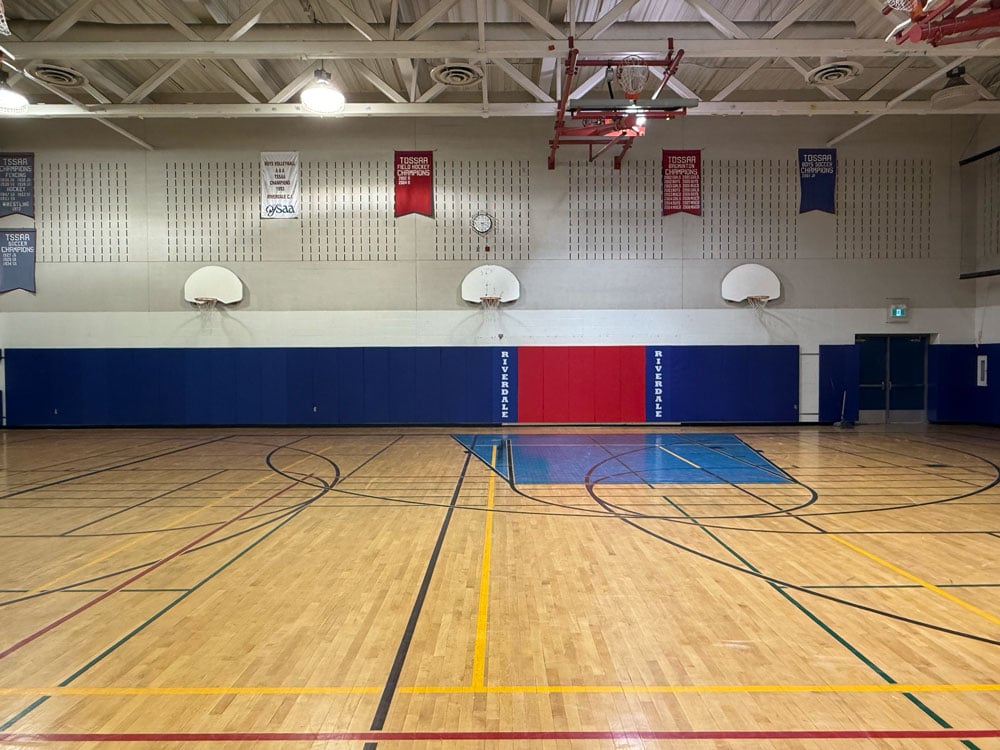
Permanent padding is attached directly to the wall using screws through a plywood or OSB backing board, providing the most secure attachment and is appropriate for dedicated gymnasium spaces. Installation typically requires a drill and drywall screws for standard wall surfaces or Tapcon screws for concrete, brick, or cement walls and can be handled by our experienced installers or facility managers.
Removable Wall Padding
Removable systems use Velcro strips to attach padding to the wall, allowing panels to be taken down when the space needs to be used for other purposes. This option works well for multi-use facilities where folding gym mats may be needed in the same location but in a lot of cases, a permanent option is better suited. With busy schedules at play, students can sometimes be asked to replace the padding on the wall after it has been taken down and through no fault of their own, it ends up crooked or hanging off the wall, leading to an increased risk of injury.
How to Handle Custom Padding Requirements
Every gymnasium has unique features that sometimes can require extremely customized solutions that account for electrical outlets, columns, beams, doors, windows, and other obstacles during the planning process.
To help walk our clients through the process, we employ an in-house design team that specializes in custom padding projects. Our padding team works with facility operators to create precise cutouts for outlets and switches, wrap padding around columns and beams of any shape, cover stage structures and other non-standard surfaces, and address unusual wall configurations or architectural features.
The basis of every good padding project begins with accurate measurements. We often will send a member of our team to take detailed measurements where and when possible, or rely on internal employees or external contractors to do so. Once we have these details, our design team is able to mock up detailed 3D CAD drawings along with helpful installation instructions.
Can You Add School Branding to Gymnasium Padding?
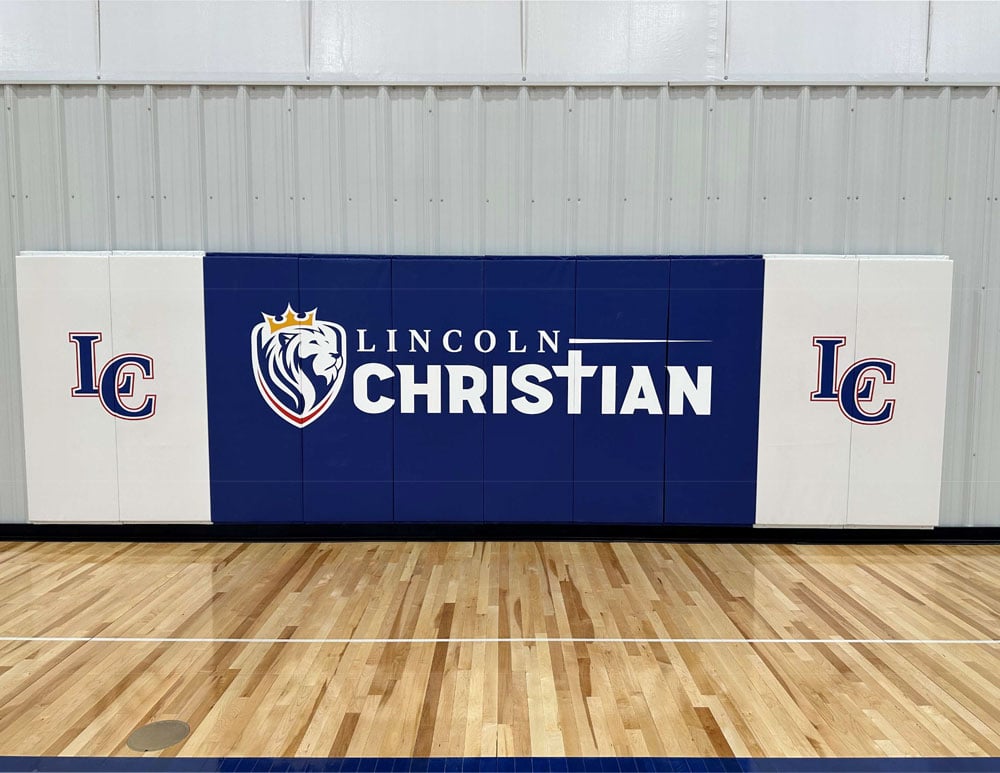
Yes, you can! Modern printing technology allows facilities to incorporate team logos, school names, mascots, and colors beautifully into their padding systems. We proudly offer digitally printed padding that features durable, bright graphics that do not peel or wear off like traditional decals.
Custom graphic padding serves a dual purpose by protecting athletes while giving school spirit a much needed boost. The result is a gymnasium that looks intentional rather than institutional.
How to Budget for a Gymnasium Padding Project
Padding costs vary based on total coverage area, thickness requirements, installation method, and customization options.
We always recommend facility operators start by measuring the total linear footage of wall space that requires padding and then multiplying by the height (typically 6 feet) to determine total square footage. If any columns, posts or stages need to be included, be sure to take those measurements separately and include photographs where possible.
Request quotes from suppliers that include both materials and installation if your maintenance team will not be handling the work. Some facilities choose to install padding themselves using the detailed instructions and CAD drawings provided with each order.
When comparing quotes, ensure that all suppliers are specifying padding that meets ASTM F2440 standards, as lower-priced options may use thinner foam or lower-density materials that do not provide adequate protection. If the price seems too good to be true, it very likely is.
Working with Sport Systems on Your Padding Project
Our team has designed, manufactured, and installed custom padding for schools across Canada and the United States for well over 40 years now. Our team understands the practical challenges facility operators face when balancing safety requirements with budget constraints and architectural limitations.
Given that every padding project begins with fully understanding your specific needs, our team works hand-in-hand with you to identify coverage requirements, evaluate existing conditions, and develop a solution that fits your facility and budget. From simple flat wall coverage to complex custom configurations, our aim is always to deliver reliable padding solutions built on-time and on-budget.
If you are ready to improve safety in your gymnasium, contact our padding team today to discuss your requirements.
FAQs About School Gymnasium Padding Requirements
What is the recommended minimum clearance behind basketball backboards?
The NFHS recommends at least 3 feet of unobstructed space outside court boundaries, with 10 feet being the preferred clearance for maximum safety. We recommend installing a minimum of 16 feet wide by 6 feet high of safety padding behind each basketball goal to protect athletes who cross the baseline.
How thick should gymnasium wall padding be for school basketball courts?
For most school gymnasium applications, 2-inch-thick foam padding is the standard specification. We use high-density foam cores that compress on impact to absorb energy and then return to their original shape. This thickness meets ASTM F2440 impact attenuation requirements for typical athletic contact.
Is gymnasium wall padding required by law for school facilities?
No single regulatory body mandates wall padding for all school facilities. However, the NFHS sets expectations for court clearance and safety zones, and facilities that cannot demonstrate compliance face increased liability exposure.
How often should gymnasium padding be inspected and replaced?
Facilities should inspect wall padding annually for compressed foam, surface damage, and attachment integrity. Most padding systems should be evaluated for replacement every 7 to 10 years depending on usage.
Can wall padding be customized with school logos and colors?
We proudly offer digitally printed padding featuring school logos, mascots, team names, and custom colors. The graphics are adhered directly to the vinyl surface using a durable printing process that resists peeling and wear. Custom graphic padding builds school spirit while delivering the same impact protection as solid-color panels.
What areas besides walls need padding in a school gymnasium?
Beyond walls, facilities should consider padding for columns and structural supports, stage structures, folded bleacher storage areas, doorways and door frames, and basketball system poles and bases. Together, we can help you design custom padding solutions for all of these applications to ensure consistent protection throughout the playing area.